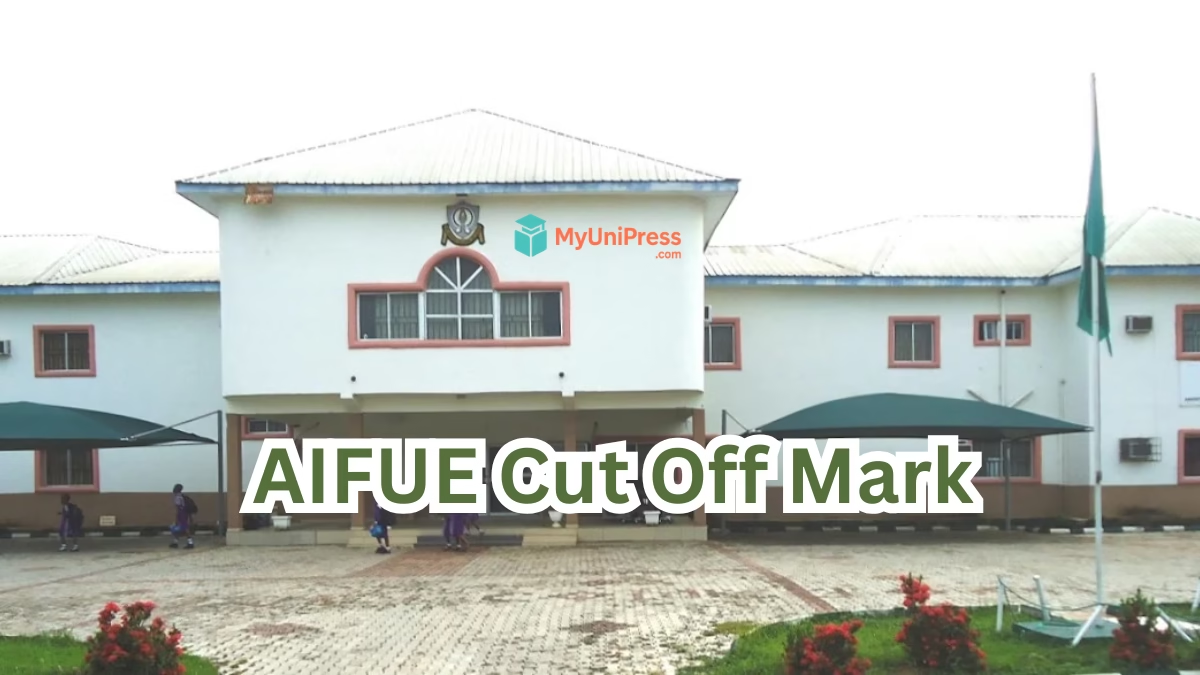
Every admission season, the AIFUE cut off mark becomes one of the most searched-for pieces of information among candidates hoping to study at Alvan Ikoku Federal University of Education, Owerri. This is understandable.
The cut off mark is the first gatekeeper standing between a candidate’s JAMB result and their dream of becoming an undergraduate. Score below it, and an applicant cannot proceed to the next stage of admission, no matter how strong their O’Level result is.
Score at or above it, and the door to Post-UTME screening, departmental selection, and eventual admission opens.
Beyond the JAMB cut off mark, admission requirements as a whole – O’Level credits, subject combinations, Direct Entry qualifications, and Post-UTME screening criteria — determine whether a qualified candidate actually secures a placement in their preferred course.
For UTME candidates, parents, and admission seekers tracking the 2026/2027 academic session, understanding these requirements early helps avoid the common mistakes that cost thousands of Nigerian students admission every year: wrong subject combinations, missing O’Level credits, incomplete document uploads, or simply not knowing the correct AIFUE JAMB cut off mark before applying.
This guide breaks down everything admission seekers need: the official cut off mark, a course-by-course breakdown, the full list of programmes offered, and detailed admission requirements for the 2026/2027 session.
AIFUE Cut Off Mark for 2026/2027
The official AIFUE cut off mark for the 2026/2027 academic session is 150.
This means any candidate who chose Alvan Ikoku Federal University of Education as a first choice institution and scored 150 or above in the 2026 UTME is eligible to proceed to the Post-UTME and Direct Entry screening exercise.
This figure aligns with the national benchmark set by the Joint Admissions and Matriculation Board (JAMB) at its 2026 Policy Meeting on Admissions held in Abuja, where stakeholders, vice-chancellors, and the Minister of Education retained 150 as the minimum admissible score for university admissions nationwide.
AIFUE, as a federal university, adopted this same benchmark for the 2026/2027 exercise rather than setting an institutional cut off above the national minimum, a pattern consistent with how the institution has approached admissions since its post-UTME notice for the session was released.
It is worth noting that meeting the 150 cut off mark only qualifies a candidate to apply for screening — it does not guarantee automatic admission.
Final placement still depends on a candidate’s O’Level grades, subject combination, available departmental slots, and performance during the screening exercise.
AIFUE 2026/2027 Admission Overview
| Institution Name | Academic Session | JAMB Cut Off Mark | Admission Status |
|---|---|---|---|
| Alvan Ikoku Federal University of Education (AIFUE), Owerri | 2026/2027 | 150 | Post-UTME/Direct Entry registration ongoing; admission list to follow JAMB CAPS release |
AIFUE Departmental Cut Off Mark for All Courses 2026/2027
AIFUE has not published a separate departmental cut off mark list that differs from its general institutional benchmark of 150 for the 2026/2027 session.
In practice, this means every candidate who scores 150 and above is technically eligible to apply for screening in any course of their choice, subject to meeting the relevant O’Level and subject combination requirements.
However, demand is never evenly spread across all 50-plus programmes. Some courses, particularly in the sciences and management disciplines, traditionally attract far more applicants than available slots, which pushes the realistic admission score (after Post-UTME aggregate scoring) higher than the bare 150 cut off.
Where this is the case below, the figures are clearly marked as estimated, based on previous admission trends at AIFUE and comparable federal universities of education, and not as officially confirmed departmental cut off marks.
Faculty of Arts
| Course | Official JAMB Cut Off |
|---|---|
| B.A. English Studies | 150 |
| B.A. (Ed.) English Studies | 150 |
| B.A. Christian Religious Studies | 150 |
| B.A. (Ed.) Christian Religious Studies | 150 |
| B.A. (Ed.) Creative Arts Education | 150 |
| B.A. Fine and Applied Arts | 150 |
| B.A. French | 150 |
| B.A. (Ed.) French | 150 |
| B.A. (Ed.) History | 150 |
| B.A. History and Diplomatic Studies | 150 |
| B.A. (Ed.) Igbo | 150 |
| B.A. (Ed.) Language and Communication Arts | 150 |
| B.A. Linguistics | 150 |
| B.A. Music | 150 |
| B.A. (Ed.) Music | 150 |
| B.A. Theatre Arts | 150 |
Faculty of Education
| Course | Official JAMB Cut Off |
|---|---|
| B.Ed. Guidance and Counselling | 150 |
| B.Ed. Educational Management | 150 |
Faculty of Specialized Education
| Course | Official JAMB Cut Off |
|---|---|
| B.Ed. Early Childhood Education | 150 |
| B.Ed. Primary Education | 150 |
| B.Ed. Special Needs Education | 150 |
| B.Ed. Adult and Continuing Education | 150 |
Faculty of Social and Management Sciences
| Course | Official JAMB Cut Off |
|---|---|
| B.Sc. Accounting | 150 |
| B.Sc. Economics | 150 |
| B.Sc. (Ed.) Economics | 150 |
| B.Sc. Public Administration | 150 |
| B.Sc. Marketing | 150 |
| B.Sc. Political Science | 150 |
| B.Sc. (Ed.) Political Science | 150 |
| B.Sc. Sociology | 150 |
| B.Sc. Geography | 150 |
| B.Sc. (Ed.) Geography | 150 |
| B.Sc. (Ed.) Social Studies | 150 |
| B.Sc. Library and Information Studies | 150 |
Faculty of Sciences
| Course | Official JAMB Cut Off |
|---|---|
| B.Sc. Computer Science | 150 |
| B.Sc. (Ed.) Computer Education | 150 |
| B.Sc. Information and Communication Technology (ICT) | 150 |
| B.Sc. Public Health | 150 |
| B.Sc. Biology | 150 |
| B.Sc. (Ed.) Biology | 150 |
| B.Sc. Chemistry | 150 |
| B.Sc. (Ed.) Chemistry | 150 |
| B.Sc. Mathematics | 150 |
| B.Sc. (Ed.) Mathematics | 150 |
| B.Sc. Physics | 150 |
| B.Sc. (Ed.) Physics | 150 |
| B.Sc. (Ed.) Integrated Science | 150 |
| B.Sc. (Ed.) Health Education | 150 |
| B.Sc. (Ed.) Human Kinetics | 150 |
Faculty of Vocational and Technology Education
| Course | Official JAMB Cut Off |
|---|---|
| B.Sc. (Ed.) Business Education | 150 |
| B.Sc. (Ed.) Entrepreneurship Education | 150 |
| B.Sc. Industrial Technology | 150 |
| B.Agric. Agricultural Science | 150 |
| B.Sc. (Ed.) Agricultural Education | 150 |
| B.Sc. (Ed.) Home Economics | 150 |
| B.Sc. (Ed.) Technology Education | 150 |
Note: “Open” indicates the course is generally less subscribed and most candidates who meet the 150 cut off and screening requirements stand a strong chance of admission. “Moderately competitive” and “Highly competitive” reflect estimated demand pressure based on past admission cycles, not an officially declared higher cut off mark.
Courses Offered at AIFUE Grouped by Faculty
Alvan Ikoku Federal University of Education currently runs more than 50 undergraduate degree programmes across six faculties, following the addition of 20 new programmes approved under the administration of the current Vice-Chancellor, Professor Stella Ngozi Lemchi, since July 2025.
Here is the full list as presented by the university for the 2026/2027 admission exercise.
Faculty of Arts:
- B.A. Christian Religious Studies
- B.A. (Ed.) Christian Religious Studies
- B.A. (Ed.) Creative Arts Education
- B.A. English Studies
- B.A. (Ed.) English Studies
- B.A. Fine and Applied Arts
- B.A. French,
- B.A. (Ed.) French
- B.A. (Ed.) History
- B.A. History and Diplomatic Studies
- B.A. (Ed.) Igbo
- B.A. (Ed.) Language and Communication Arts
- B.A. Linguistics
- B.A. Music
- B.A. (Ed.) Music
- B.A. Theatre Arts.
Faculty of Education:
- B.Ed. Guidance and Counselling
- B.Ed. Educational Management.
Faculty of Specialized Education:
- B.Ed. Adult and Continuing Education
- B.Ed. Early Childhood Education
- B.Ed. Primary Education
- B.Ed. Special Needs Education.
Faculty of Social and Management Sciences:
- B.Sc. Accounting
- B.Sc. Economics
- B.Sc. (Ed.) Economics
- B.Sc. Geography
- B.Sc. (Ed.) Geography
- B.Sc. Library and Information Studies
- B.Sc. Marketing
- B.Sc. Political Science
- B.Sc. (Ed.) Political Science
- B.Sc. Public Administration
- B.Sc. Sociology
- B.Sc. (Ed.) Social Studies.
Faculty of Sciences:
- B.Sc. Biology
- B.Sc. (Ed.) Biology
- B.Sc. Chemistry
- B.Sc. (Ed.) Chemistry
- B.Sc. Computer Science
- B.Sc. (Ed.) Computer Education
- B.Sc. (Ed.) Health Education
- B.Sc. (Ed.) Human Kinetics
- B.Sc. Information and Communication Technology (ICT)
- B.Sc. (Ed.) Integrated Science
- B.Sc. Mathematics
- B.Sc. (Ed.) Mathematics
- B.Sc. Physics
- B.Sc. (Ed.) Physics
- B.Sc. Public Health.
Faculty of Vocational and Technology Education:
- B.Agric. Agricultural Science
- B.Sc. (Ed.) Agricultural Education
- B.Sc. (Ed.) Business Education
- B.Sc. (Ed.) Entrepreneurship Education
- B.Sc. (Ed.) Home Economics
- B.Sc. Industrial Technology
- B.Sc. (Ed.) Technology Education.
AIFUE Admission Requirements for 2026/2027
Meeting the AIFUE admission requirements involves more than just clearing the JAMB cut off mark.
Candidates must satisfy criteria at four different stages: UTME, O’Level, Direct Entry (where applicable), and Post-UTME screening.
Requirements for UTME Candidates
To be considered for admission through UTME, a candidate must choose Alvan Ikoku Federal University of Education as their first choice institution on the JAMB portal, or change their institution to AIFUE at any JAMB-accredited CBT centre.
The candidate must score at least 150 in the 2026 UTME and must have registered the correct subject combination relevant to their intended course.
Candidates must also upload their O’Level results on the JAMB CAPS portal, as failure to do this can lead to automatic disqualification regardless of how high the UTME score is.
O’Level Requirements
Every applicant, whether through UTME or Direct Entry, must possess a minimum of five credits in WAEC, NECO, or GCE, including English Language and Mathematics, plus three other subjects relevant to the chosen course.
These five credits must be obtained in not more than two sittings. At least two of the credits, beyond English and Mathematics, must be directly relevant to the candidate’s intended field of study.
Results that are still “awaiting” at the point of screening are generally not accepted unless the university grants special consideration.
Direct Entry Requirements
Direct Entry applicants seeking admission directly into the relevant level of a degree programme must possess one of the following: an NCE with a minimum of a Merit pass in relevant subjects, a National Diploma (ND) or Higher National Diploma (HND) with at least a Lower Credit, two or more A’ Level/IJMB/JUPEB passes in relevant subjects, or a first degree from a recognised institution in a related discipline.
Direct Entry candidates must still meet the same O’Level credit requirements as UTME candidates and must purchase the JAMB Direct Entry form selecting AIFUE as their institution of choice before proceeding to the university’s own screening process.
AIFUE Post-UTME Screening Requirements
Candidates who meet the cut off mark must register for the Post-UTME/Direct Entry screening exercise through the AIFUE official portal.
The process involves entering the JAMB registration number, completing an online profile, selecting the appropriate programme category (Degree Regular or Direct Entry/Post-NCE), generating a payment invoice, and paying the screening fee through Remita at Alvana Microfinance Bank or any commercial bank.
After payment, candidates must upload a recent passport photograph, their O’Level result, birth certificate, and Local Government Identification letter, then submit and print the application success page for reference.
Candidates are strongly advised to provide accurate information throughout, as discrepancies between submitted documents and JAMB records are a common reason candidates lose admission slots even after meeting the cut off mark.
Frequently Asked Questions
1. What is the AIFUE cut off mark for the 2026/2027 academic session?
The AIFUE cut off mark for 2026/2027 is 150, in line with the national minimum benchmark approved by JAMB for university admissions this session.
2. Is the AIFUE departmental cut off mark different from the general cut off mark?
No official departmental cut off mark distinct from 150 has been released for 2026/2027. All applicants who score 150 and above are eligible to apply for screening in any course, although competitive courses may have higher effective admission scores after the aggregate screening process.
3. Can a candidate with exactly 150 in UTME gain admission into AIFUE?
Yes, a candidate with 150 is eligible to apply for screening. However, actual admission also depends on O’Level grades, subject combination, and the number of available slots in the chosen department, especially for highly competitive courses like Computer Science, Accounting, and Economics.
4. What is the AIFUE Direct Entry cut off mark?
There is no separate numerical JAMB score for Direct Entry, since DE candidates are assessed mainly on their NCE, ND/HND, A’ Level, or first degree qualifications alongside their O’Level results, rather than a UTME score.
5. Does AIFUE conduct a written Post-UTME screening test?
For the 2026/2027 exercise, AIFUE’s screening process is primarily document-based, requiring candidates to register online, pay the screening fee, and upload required documents for verification, rather than sitting a separate computer-based aptitude test.
6. What O’Level subjects are compulsory for AIFUE admission?
English Language and Mathematics are compulsory for virtually all courses, alongside at least three other credits relevant to the chosen programme, obtained in not more than two sittings.
7. Can I still apply to AIFUE if it was not my first choice in JAMB?
Yes. Candidates who did not initially choose AIFUE can visit any JAMB-accredited CBT centre or JAMB office to change their institution to Alvan Ikoku Federal University of Education before the screening deadline.
8. How many faculties and courses does AIFUE offer?
AIFUE currently runs more than 50 undergraduate degree programmes spread across six faculties: Arts, Education, Specialized Education, Social and Management Sciences, Sciences, and Vocational and Technology Education.
9. What documents are required for the AIFUE Post-UTME screening?
Candidates need a recent passport photograph, their O’Level result, birth certificate, and Local Government Identification letter, all uploaded through the official AIFUE admission portal.
10. Is Alvan Ikoku still a college of education or a full university?
Alvan Ikoku was upgraded from a Federal College of Education to a full-fledged university, Alvan Ikoku Federal University of Education, in October 2023, and now runs full degree programmes alongside its traditional NCE and Professional Diploma in Education (PDE) programmes.
11. How can I check if I have been admitted into AIFUE?
Admission status can be checked through the JAMB Central Admissions Processing System (CAPS) once the university uploads its admission list, in addition to checking the AIFUE admission portal directly for any institution-specific updates.
12. Where can I get the latest AIFUE admission news?
Candidates should regularly check the official AIFUE website and portal, as well as JAMB’s official channels, for the latest AIFUE admission news, including screening dates, deadline extensions, and admission list releases.
Conclusion
The AIFUE cut off mark for the 2026/2027 academic session stands at 150, matching the national minimum set by JAMB for university admissions this cycle. While this single figure determines eligibility for Post-UTME screening, real admission into Alvan Ikoku Federal University of Education depends on a fuller picture: the right O’Level credits including English Language and Mathematics, the correct subject combination for your chosen course, complete and accurate document uploads, and, for competitive courses such as Computer Science, Accounting, and Economics, a stronger overall profile than the bare minimum score.
Direct Entry candidates, meanwhile, need to ensure their NCE, ND/HND, A’ Level, or first degree qualifications align with their intended department.
With more than 50 degree programmes spread across six faculties, AIFUE offers a wide range of options for prospective undergraduates. Candidates and parents are advised to keep checking official AIFUE and JAMB platforms for updates, since admission requirements, screening formats, and deadlines can be reviewed from one session to the next.





Leave a Comment