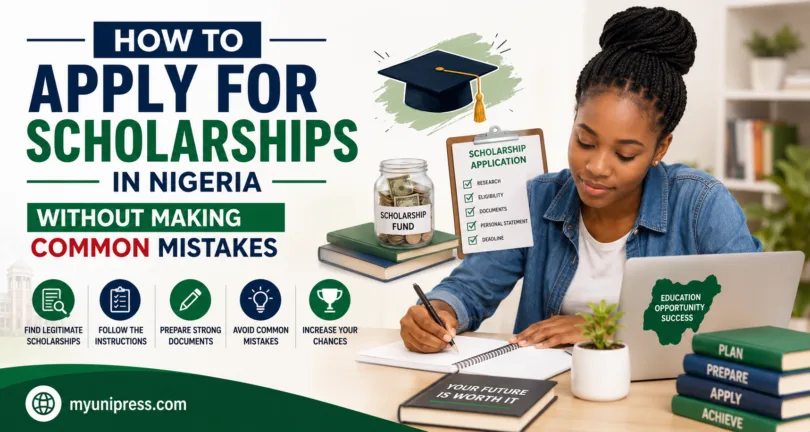
Understanding how to apply for scholarships in Nigeria without making common mistakes will protect your application, boost your selection chances, and help secure funding for your academic program. The difference between successful applicants and rejected candidates rarely comes down to intelligence alone. Most rejections stem from preventable application mistakes.
Securing financial support for higher education in Nigeria is a major milestone for undergraduate and postgraduate students. With rising tuition fees, expensive study materials, and general cost-of-living adjustments, scholarships offered by government agencies, multinational oil companies, and private foundations have become highly competitive. Thousands of qualified candidates submit applications yearly, but only a small percentage land the award.
Major Scholarship Categories in Nigeria
Before beginning the application process, you must recognize the types of scholarships available to Nigerian students. Each category features distinct qualification criteria, documentation requirements, and funding scopes.
1. Oil and Gas Corporate Scholarships
Multinational oil and gas companies operating in Nigeria provide some of the most lucrative undergraduate and postgraduate awards. Examples include the NNPC/Chevron Joint Venture Scholarship, TotalEnergies Young Talent Program, Agip Postgraduate Scholarship, and the Shell Petroleum Development Company (SPDC) Scholarship. These awards focus heavily on STEM fields, community host areas, and academic excellence.
2. Government and Federal Agency Schemes
The Federal Government of Nigeria offers structured funding programs through bodies like the Federal Scholarship Board (FSB) Bilateral Education Agreement (BEA), the Petroleum Technology Development Fund (PTDF), and the Tertiary Education Trust Fund (TETFund). These schemes cater to both domestic and international study.
3. State Government Bursaries
State governments regularly award bursaries and indigene scholarships to students enrolled in accredited public institutions. Qualifications depend on proving your local government area (LGA) origin and maintaining valid admission credentials.
4. Private Foundations and NGOs
Philanthropic bodies such as the Jim Ovia Foundation, MTN Foundation, Wole Ogunyemi Foundation, and the Mastercard Foundation offer merit and need-based financial aid to eligible Nigerian youths.
| Scholarship Provider Category | Target Audience | Primary Focus Area | Typical Funding Coverage |
| Oil & Gas Multinationals | Undergraduates (100–200 Level) | STEM, Medicine, Law | Annual stipends (₦150,000 – ₦500,000) |
| Federal Agencies (PTDF/FSB) | Postgraduates & Undergraduates | Technology, Energy, Sciences | Full tuition, living allowances, travel |
| State Governments | State Indigenes in Tertiary Institutions | General Academic Support | One-time or annual bursaries |
| Private Foundations | High Achievers & Indigent Students | Education, Tech, Innovation | Tuition coverage and tech allowances |
Essential Requirements and Documentation Checklist
A primary cause of immediate application disqualification is missing or incorrectly formatted documentation. Scholarship portals use automated pre-screening tools that reject incomplete submissions without human review.
To avoid last-minute issues, scan and save clear digital copies of the following standard documents on your cloud storage:
- Official Admission Letter: Issued by JAMB and your institution confirming full-time enrollment.
- Academic Transcripts/Statements of Result: Showing your Cumulative Grade Point Average (CGPA) for current undergraduates, or O’Level certificates (WAEC/NECO) for freshers.
- Certificate of Origin: Signed and stamped by your Local Government Area (LGA) authority.
- National Identification Number (NIN): Issued by NIMC, matching the exact name structure across your academic records.
- Birth Certificate or Age Declaration: Issued by the National Population Commission (NPC) or a recognized court.
- Student Identification Card: Valid ID issued by your university, polytechnic, or college of education.
- Passport Photographs: High-resolution headshots taken against a clean red or white background.
- Letters of Recommendation: Signed letters from your Head of Department (HOD), academic advisor, or community leader.
How to Apply for Scholarships in Nigeria Without Making Common Mistakes
Applying for financial aid requires an organized approach. Following a structured path reduces processing errors and ensures submission compliance.
Phase 1: Research and Eligibility Verification
Begin your search months before application portals open. Monitor scholarship tracking platforms, university bulletin boards, and official corporate channels. Verify criteria including CGPA cut-offs (often 3.50/5.00 or higher), course restrictions, level of study, and state-of-origin clauses. Never apply for schemes where you do not meet basic requirements.
Phase 2: Document Standardization and Formatting
Organize your documents carefully before opening an application portal. Ensure name order is consistent across all credentials (e.g., Surname First Name Middle Name). If discrepancies exist, secure a legally sworn Affidavit of Name Correction and a published newspaper change of name advert. Convert all physical files into clear PDF formats, keeping sizes under 500 KB unless specified otherwise.
Phase 3: Drafting Personal Statements and Essays
Scholarship essays give selection panels direct insight into your character, ambition, and financial need. Write original content directly addressing the prompt. Structure your essay with a clear introduction, core evidence of academic performance or community work, and a concluding explanation of how the scholarship supports your career goals.
Phase 4: Final Portal Submission
Complete form fields with accurate information matching your official documents. Review entries for typographical errors, uploaded document orientations, and functional contact information. Submit your entry at least three days before the deadline to avoid server overloads.
Critical Scholarship Mistakes to Avoid
Understanding where applicants make errors helps you avoid losing out on funding. Below are major mistakes identified by selection boards.
1. Inconsistent Name Alignment Across Credentials
A common cause of automatic disqualification in Nigerian scholarship processing is name mismatching. If your JAMB result reads Okonkwo Chukwuma Emmanuel, but your Bank Verification Number (BVN) and bank account display Okonkwo Emmanuel, automated verification systems will flag the entry for identity mismatch.
2. Submitting Poor-Quality Scans and Mobile Photos
Never upload low-resolution mobile photographs showing shadow reflections, angled perspectives, or cropped borders. Portals reject unreadable transcripts and certificates. Use desktop flatbed scanners or dedicated document scanning apps set to clear PDF outputs.
3. Relying on AI-Generated or Template Essays
Scholarship boards use plagiarism detectors and AI content checkers. Submitting generic personal statements produced by automated tools signals low effort. Write from personal experience, detailing authentic challenges, leadership experiences, and community engagement.
4. Ignoring CGPA and Course Eligibility Rules
Applying for awards reserved for 200-level students while in 100-level, or applying with a 3.10 CGPA when the benchmark is 3.50, leads to immediate rejection. Review application guidelines carefully before starting.
5. Applying Near the Deadline
Submitting your application on the closing date exposes you to network failures, portal crashes, and payment gateway glitches for schemes requiring administrative fees. Complete and submit entries days in advance.
| Common Application Mistake | Processing Impact | Prevention & Solution |
| Name Mismatches | Identity validation error | Secure an Affidavit and ensure BVN/NIN alignment |
| Blurry Document Scans | Verification rejection | Use flatbed scanners; output clean 300 DPI PDFs |
| Generic/AI Essays | High plagiarism score | Write original stories tailored to the sponsor’s goals |
| Wrong Level/CGPA | Automated exclusion | Confirm eligibility guidelines before applying |
| Last-Minute Submission | Network timeout failures | Finish entries 3–5 days prior to portal closure |
Strategy for Scholarship Aptitude Tests and Interviews
Many scholarship boards require shortlisted candidates to take competitive aptitude tests or attend virtual or physical panel interviews.
Acing the Aptitude Test
Scholarship screening tests usually assess numerical reasoning, verbal ability, critical thinking, and current affairs.
- Practice Past Questions: Obtain accurate past questions for specific awards (e.g., Dragnet formats for oil industry scholarships, GMAT-style numerical tests for private foundations).
- Time Management: Most tests give less than a minute per question. Skip difficult questions and return to them if time allows.
- Verify System Requirements: For remote proctored exams, secure a stable internet connection, a functioning webcam, and a quiet testing environment well before exam time.
Navigating Selection Interviews
If selected for an interview, panel members will evaluate your academic foundation, leadership skills, and genuine financial need.
- Know Your Application: Review your personal statement and submitted documents. Panels frequently ask about projects or achievements mentioned in your essay.
- Understand the Sponsor: Research the corporate history, core values, and recent CSR projects of the sponsoring organization.
- Dress Professionally: Wear formal corporate attire or clean traditional wear to communicate maturity and commitment.
Frequently Asked Questions (FAQs)
Can 100-level tertiary students apply for scholarships in Nigeria?
Yes, several scholarship schemes cater specifically to first-year undergraduates. Many oil and gas schemes use your O’Level results and JAMB scores for initial entry. Other programs require your first-semester 100-level results to confirm a stable CGPA before disbursement.
What should I do if my name is arranged differently on my documents?
If your certificates, admission letters, and NIN display different name orders, obtain a sworn Affidavit of Confirmation of Name from a High Court and publish it in a national newspaper. Upload these supporting legal items alongside your documents to prevent disqualification.
Are fully funded undergraduate scholarships available within Nigeria?
Yes. Major corporate programs provide comprehensive annual stipends that cover tuition, accommodation, and educational materials throughout your program duration, subject to maintaining the required CGPA benchmarks.
Can I hold two scholarships at the same time in a Nigerian university?
Most scholarship boards explicitly prohibit holding multiple major awards simultaneously. Sponsoring organizations share candidate databases during verification. If discovered, you risk losing both awards and facing disciplinary action from your institution.
How do I know if a scholarship advertisement is genuine?
Authentic scholarships never require cash deposits, processing fees, or payment for awards. Always verify announcements through official company websites, verified media outlets, or your institution’s Dean of Student Affairs office.


Leave a Comment