
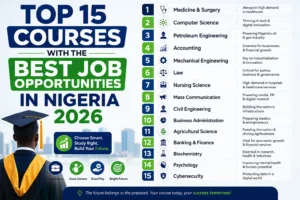
15 Courses With the Best Job Opportunities in Nigeria: Choosing the right university course is one of the most important decisions a Nigerian student will ever make.
With a population of over 220 million people, a growing technology sector, expanding healthcare demand, and increasing foreign investment, the need for skilled, degree-holding professionals has never been greater. Yet many students still choose courses based on tradition, family pressure, or status, rather than actual market demand.
The truth is that not all degrees carry the same employment weight. Some courses consistently produce graduates who land high-paying jobs within months of completing the NYSC, while others leave graduates searching for years.
In 2026, the Nigerian job market increasingly rewards technical skills, digital literacy, and professional certifications, and the best courses reflect this shift.
Whether you are a UTME candidate deciding on a course of study, a parent guiding your child, or a professional considering a career change through a postgraduate programme, this comprehensive guide is for you.
Below are the top 15 courses with the best job opportunities in Nigeria in 2026, ranked by employability, earning potential, and industry demand.
Quick Overview
The table below provides a snapshot of each course, its primary sector, average entry salary, and employability rating in Nigeria’s 2026 labour market.
| S/N | Course | Sector | Avg. Entry Salary (₦/month) | Employability Rating |
|---|---|---|---|---|
| 1 | Medicine & Surgery (MBBS) | Healthcare | ₦350,000 – ₦600,000 | ⭐⭐⭐⭐⭐ |
| 2 | Engineering (Petroleum, Civil, Elec.) | Engineering / Oil & Gas | ₦250,000 – ₦700,000 | ⭐⭐⭐⭐⭐ |
| 3 | Law (LLB) | Legal / Public Service | ₦150,000 – ₦400,000 | ⭐⭐⭐⭐½ |
| 4 | Computer Science / Software Engineering | Technology / Fintech | ₦200,000 – ₦800,000 | ⭐⭐⭐⭐⭐ |
| 5 | Nursing Science | Healthcare | ₦200,000 – ₦450,000 | ⭐⭐⭐⭐⭐ |
| 6 | Accounting / Finance | Banking / Finance | ₦150,000 – ₦500,000 | ⭐⭐⭐⭐½ |
| 7 | Pharmacy (B.Pharm) | Healthcare / Manufacturing | ₦200,000 – ₦500,000 | ⭐⭐⭐⭐½ |
| 8 | Data Science / Statistics | Technology / Analytics | ₦250,000 – ₦900,000 | ⭐⭐⭐⭐⭐ |
| 9 | Architecture | Construction / Real Estate | ₦150,000 – ₦400,000 | ⭐⭐⭐⭐ |
| 10 | Economics | Finance / Policy / Banking | ₦150,000 – ₦450,000 | ⭐⭐⭐⭐ |
| 11 | Medical Laboratory Science | Healthcare / Diagnostics | ₦180,000 – ₦400,000 | ⭐⭐⭐⭐½ |
| 12 | Agricultural Science / Food Technology | Agribusiness / Manufacturing | ₦120,000 – ₦350,000 | ⭐⭐⭐⭐ |
| 13 | Mass Communication / Journalism | Media / PR / Digital | ₦100,000 – ₦350,000 | ⭐⭐⭐½ |
| 14 | Estate Management / Qty. Surveying | Real Estate / Construction | ₦150,000 – ₦400,000 | ⭐⭐⭐⭐ |
| 15 | Cybersecurity | Technology / Banking / Defence | ₦300,000 – ₦1,000,000 | ⭐⭐⭐⭐⭐ |
Note: Salary figures are indicative estimates for fresh graduates in the Nigerian private sector as of 2026. Actual salaries vary by employer, location, and specialisation.
Top 15 Courses With the Best Job Opportunities in Nigeria
1. Medicine and Surgery (MBBS)
Sector: Healthcare | Programme Duration: 6 years + 1-year housemanship + NYSC
Medicine and Surgery remains the most prestigious and consistently in-demand course in Nigeria. The country faces a severe doctor-to-patient ratio crisis, with the World Health Organisation recommending at least 1 doctor per 1,000 people, a benchmark Nigeria is still working towards.
This structural shortage means that every certified medical doctor who completes housemanship and mandatory NYSC is virtually guaranteed employment.
In 2026, Nigerian doctors are in high demand not just in public hospitals but also in private healthcare institutions, multinational pharmaceutical companies, health tech startups, and international organisations. The Japa wave, the mass emigration of Nigerian professionals, has paradoxically increased local demand for medical doctors, as hospitals struggle to fill vacancies.
Career Paths
General Practice, Surgery, Paediatrics, Obstetrics & Gynaecology, Radiology, Psychiatry, Public Health, Medical Research, Health Administration, International Health Organisations (WHO, UNICEF).
Top Schools to Study MBBS in Nigeria
| University | State | JAMB Cut-Off Mark Needed |
|---|---|---|
| University of Lagos (UNILAG) | Lagos | 200+ |
| University of Ibadan (UI) | Oyo | 200+ |
| Ahmadu Bello University (ABU) | Kaduna | 200+ |
| Bayero University Kano (BUK) | Kano | 200+ |
| University of Nigeria Nsukka (UNN) | Enugu | 200+ |
Pro Tip: Medicine is a 6-year programme followed by a 1-year housemanship and 1-year NYSC. While the path is long, the return on investment is among the highest of any degree in Nigeria.
2. Engineering
Specialisations: Petroleum, Civil, Electrical, Mechanical, Chemical
Engineering is a broad field, but in Nigeria, Petroleum Engineering consistently sits at the very top of the salary chart, largely because Nigeria’s economy is heavily tied to oil and gas production. Civil, Electrical, and Mechanical Engineering graduates are also in very high demand, driven by Nigeria’s massive infrastructure deficit and the growing construction and manufacturing sectors.
With the Federal Government’s renewed push on infrastructure development, power sector reform, and the Dangote Refinery now in full operation, engineering graduates in 2026 face a robust job market. Multinational oil companies, construction giants, telecoms firms, power companies, and government agencies all compete for qualified Nigerian engineers.
In-Demand Engineering Specialisations in Nigeria 2026
| Specialisation | Primary Employers | Avg. Salary (₦/month) |
|---|---|---|
| Petroleum Engineering | NNPC, Shell, Total, Chevron | ₦450,000 – ₦700,000 |
| Civil Engineering | Julius Berger, FG Ministries, CCECC | ₦250,000 – ₦500,000 |
| Electrical/Electronics Engineering | PHCN, MTN, Airtel, Telecoms firms | ₦200,000 – ₦450,000 |
| Mechanical Engineering | Dangote Group, Manufacturing firms | ₦200,000 – ₦450,000 |
| Chemical Engineering | NNPC, Refineries, FMCG firms | ₦250,000 – ₦500,000 |
Note: Engineers who supplement their degree with relevant professional certifications (e.g., COREN registration, PMP, or international oil & gas certifications) significantly improve their employment prospects and earning potential.
3. Law (LLB)
Sector: Legal / Public Service / Corporate Nigeria
A Law degree from a recognised Nigerian university, followed by a call to the Nigerian Bar via the Nigerian Law School, opens doors to one of the widest variety of career paths available to any Nigerian graduate.
In 2026, lawyers are not just found in courtrooms; they work in corporate Nigeria, the oil and gas sector, banking, insurance, real estate, and increasingly in tech companies navigating regulatory compliance.
The increasing complexity of Nigeria’s regulatory environment, from fintech regulations to data protection laws (NDPR), the Companies and Allied Matters Act (CAMA) reforms, and international arbitration, has created enormous demand for corporate and commercial lawyers.
Top law firms, financial institutions, and multinational companies pay highly competitive salaries to lawyers with the right specialisation.
Career Paths for Law Graduates
Barrister & Solicitor (Private Practice), Corporate/Commercial Law, Litigation, Human Rights Law, Legal Drafting, Notary Public, Judiciary (Magistrate/Judge), Legal Compliance Officer, Academic/Lecturing, Politics and Governance.
4. Computer Science / Software Engineering
Sector: Technology / Fintech / Remote Work
If there is one course that has seen the most dramatic increase in job opportunities in Nigeria over the past five years, it is Computer Science and Software Engineering. Nigeria’s technology sector, anchored by Lagos’ “Yaba Valley” but spreading across Abuja, Port Harcourt, and Kano, is now one of the most vibrant in Africa.
The rise of fintech giants like Flutterwave, Paystack (acquired by Stripe), PiggyVest, and Kuda Bank; the growth of e-commerce platforms; the expansion of telecom companies into digital services; and the demand for software solutions across every industry have created a near-insatiable appetite for tech talent.
In 2026, software developers and engineers with strong portfolios are being recruited locally and internationally, with many earning salaries in dollars while living in Nigeria.
Most In-Demand Tech Skills in Nigeria 2026
| Skill | Avg. Monthly Pay (Remote) | Local Demand |
|---|---|---|
| Backend Development (Python, Node.js) | $800 – $3,000 | Very High |
| Mobile Development (Flutter, React Native) | $700 – $2,500 | Very High |
| Frontend Development (React, Vue.js) | $600 – $2,000 | High |
| Cloud Engineering (AWS, Azure) | $1,000 – $4,000 | High |
| DevOps / Site Reliability Engineering | $1,200 – $4,500 | Growing |
| Machine Learning / AI Engineering | $1,500 – $6,000 | Growing Rapidly |
5. Nursing Science
Sector: Healthcare | Programme Duration: 5 years + NYSC
Nursing is one of the most reliable courses for guaranteed employment in Nigeria. The chronic shortage of trained nurses in both public and private hospitals, combined with a high global demand for Nigerian nurses abroad, makes this one of the most pragmatic degree choices in 2026.
Registered nurses are needed in virtually every state of the federation, and there is essentially no unemployment among qualified nursing graduates who pass their licensure examinations.
An added advantage: the global demand for Nigerian nurses in the United Kingdom, Canada, the United States, and the Gulf states means that ambitious nursing graduates have a clear international career pathway.
Nurses who choose to work abroad can earn multiples of what they would earn locally, making this degree one with one of the highest lifetime earning potentials when international mobility is factored in.
Career Options for Nursing Graduates
Clinical Nurse, Nurse Educator, Nurse Manager/Administrator, Community Health Nurse, Midwife, Theatre Nurse, ICU Nurse, International Healthcare (UK NHS, Saudi Arabia, Canada), Nursing Research, Public Health.
6. Accounting and Finance
Sector: Banking / Finance / Auditing / FMCG
Every business, from a small Nigerian SME to a multinational conglomerate, needs accountants and finance professionals. Accounting and Finance graduates enjoy one of the broadest employment bases of any degree in Nigeria, with opportunities spanning banking, insurance, manufacturing, oil and gas, the public sector, NGOs, and auditing firms.
In 2026, the demand for Accounting graduates who also hold or are pursuing professional certifications is especially strong. Graduates who add the ICAN (Institute of Chartered Accountants of Nigeria) or ACCA qualification to their degree dramatically increase their earning power.
Big Four accounting firms (Deloitte, PwC, KPMG, Ernst & Young) all have strong Nigerian operations and regularly recruit from Nigerian universities.
Key Employers and Salary Ranges
| Employer Type | Example Employers | Entry Salary (₦/month) |
|---|---|---|
| Commercial Banks | GTBank, Zenith, Access Bank, UBA | ₦200,000 – ₦400,000 |
| Big 4 Accounting Firms | Deloitte, PwC, KPMG, EY | ₦250,000 – ₦450,000 |
| Oil & Gas Companies | Shell, Total, Seplat | ₦350,000 – ₦600,000 |
| Manufacturing & FMCG | Dangote, Flour Mills, Nestle | ₦180,000 – ₦350,000 |
| Federal/State Government | FIRS, CBN, PENCOM | ₦150,000 – ₦300,000 |
7. Pharmacy (B.Pharm)
Sector: Healthcare / Manufacturing / Regulatory Affairs
Pharmacy graduates in Nigeria enjoy strong employment prospects driven by the country’s expanding pharmaceutical manufacturing base, growing retail pharmacy sector, and the consistent demand for qualified dispensing pharmacists in hospitals and community pharmacies. Nigeria’s pharmaceutical industry is one of the largest in Sub-Saharan Africa and continues to attract significant investment.
A key advantage of a Pharmacy degree in 2026 is the diversity of career options: from hospital pharmacy and community pharmacy to industrial pharmacy (working in drug manufacturing), regulatory affairs, pharmaceutical marketing, and academic research.
Pharmacists who register with the Pharmacists Council of Nigeria (PCN) can also own and operate their own pharmacies, making entrepreneurship a straightforward career pathway.
Career Paths
Hospital Pharmacist, Community Pharmacist, Industrial Pharmacist (Emzor, May & Baker, GSK), Regulatory Affairs Officer (NAFDAC), Pharmaceutical Sales Representative, Pharmacy Business Owner, Academic/Research.
8. Data Science and Statistics
Sector: Technology / Analytics / Finance
Data Science has emerged as one of the fastest-growing and highest-paying fields in Nigeria. As Nigerian companies, particularly in fintech, e-commerce, telecoms, and banking, become increasingly data-driven, the demand for professionals who can collect, analyse, and interpret large datasets has exploded. Statisticians and data analysts have transitioned from being back-office support roles to becoming strategic business partners.
In 2026, data professionals in Nigeria are among the most sought-after across all sectors. Companies like MTN Nigeria, Flutterwave, Konga, Interswitch, and multinational firms operating in Nigeria are offering premium salaries to attract and retain data talent.
Additionally, the remote work revolution means that Nigerian data scientists with strong skills can access international roles from Nigeria, further expanding their earning potential.
Skills That Boost a Data Science Career in Nigeria
Python, R, SQL, Machine Learning, Power BI, Tableau, Big Data (Hadoop/Spark), Business Intelligence, Statistical Modelling, Natural Language Processing (NLP), Microsoft Excel (Advanced).
9. Architecture
Sector: Construction / Real Estate / Urban Planning
Nigeria’s massive housing deficit, estimated at over 28 million units, combined with rapid urbanisation and ongoing government-led infrastructure development, ensures a steady demand for qualified architects.
Architecture graduates who register with the Architects Registration Council of Nigeria (ARCON) can work in private architectural firms, real estate development companies, government agencies, or establish their own practice.
The emergence of green building practices, smart city concepts, and the integration of technology in construction (BIM — Building Information Modelling) has also elevated the demand for tech-savvy architects in Nigeria’s 2026 job market. Architects with strong 3D rendering and CAD skills command premium fees.
10. Economics
Sector: Finance / Banking / Policy / International Development
Economics is one of Nigeria’s most versatile degrees, producing graduates who find employment across banking, insurance, financial analysis, government policy, international development, management consulting, and academia. Economists are particularly valuable in Nigeria’s current environment of macroeconomic volatility; organisations need professionals who understand inflation, exchange rate dynamics, monetary policy, and fiscal management.
Economics graduates who pursue professional certifications such as the CFA (Chartered Financial Analyst), CIBN, or a postgraduate degree in Finance or Business Administration significantly improve their career prospects and salary outlook. Development organisations like the World Bank, UNDP, and IMF also recruit Nigerian economics graduates for local and international roles.
11. Medical Laboratory Science
Sector: Healthcare / Diagnostics / Research
Medical Laboratory Scientists are indispensable to Nigeria’s healthcare system. Every hospital, health centre, and diagnostic laboratory depends on Medical Laboratory Scientists (MLS) to conduct tests that inform diagnoses and treatment decisions.
The COVID-19 pandemic dramatically highlighted the critical importance of laboratory capacity in public health, leading to increased investment in diagnostic infrastructure across Nigeria.
In 2026, the demand for qualified MLS graduates spans government hospitals, private hospitals, diagnostic centres (like Synlab, Clina-Lancet), pharmaceutical companies conducting clinical trials, public health agencies, and research institutions. Those who specialise in molecular diagnostics, clinical chemistry, or haematology are especially in demand.
12. Agricultural Science / Food Technology
Sector: Agribusiness / Manufacturing / Food Processing
Nigeria’s agricultural sector contributes significantly to GDP and employs the majority of the rural population. However, modern agribusiness, which combines technology, finance, supply chain management, and food processing, is a growing employer of graduates.
The Federal Government’s Agricultural Transformation Agenda and increasing private sector investment in agribusiness have created new career opportunities in crop science, agronomy, food processing, quality control, and agri-tech.
Food Technology graduates, in particular, are in high demand from Nigeria’s booming FMCG and food processing industry companies like Dangote, Nestle, Unilever, PZ Cussons, Dufil (makers of Indomie), and Nigerian Breweries, which regularly recruit food science and technology graduates. The rise of food safety regulations and export-oriented agribusiness has further strengthened this sector’s employment outlook.
13. Mass Communication and Journalism
Sector: Media / Digital Marketing / PR / Corporate Communications
Mass Communication has evolved dramatically in the digital age. While traditional broadcast and print journalism still offer employment opportunities, the biggest growth area in 2026 is digital media, content creation, social media management, public relations, advertising, and corporate communications.
Nigerian companies, including banks, telecoms companies, FMCG brands, and tech startups, all need skilled communications professionals.
Mass Communication graduates who build strong digital skills, including SEO, content marketing, video production, social media management, and public relations strategy, are among the most employable non-STEM graduates in Nigeria. Freelance and remote work opportunities in this field are also abundant, particularly for skilled content writers and digital marketers.
14. Estate Management / Quantity Surveying
Sector: Real Estate / Construction / Property Development
Nigeria’s real estate sector, driven by urbanisation, population growth, and increasing investment by Nigerians in the diaspora, continues to generate strong employment for Estate Management and Quantity Surveying graduates. Estate managers handle property valuation, sales, leasing, and facility management, while Quantity Surveyors are essential for costing and managing construction projects.
In 2026, the construction boom in major Nigerian cities, including Lagos, Abuja, Port Harcourt, and Kano, has kept demand for these professionals consistently high.
Real estate companies, property developers, construction firms, and government infrastructure agencies all actively recruit these graduates. Self-employment through real estate agencies and property development is also a common and lucrative career path.
15. Cybersecurity
Sector: Technology / Banking / Government / Defence
Cybersecurity is arguably the fastest-rising career field in Nigeria in 2026. As Nigeria’s digital economy expands with millions of Nigerians conducting banking, commerce, and government transactions online, the threat landscape has grown correspondingly. Nigerian banks, fintech companies, telecom operators, and government agencies have experienced significant cyberattacks, creating urgent demand for cybersecurity professionals.
The Central Bank of Nigeria (CBN) and the National Information Technology Development Agency (NITDA) have both issued directives requiring financial institutions and government agencies to build robust cybersecurity infrastructure, further driving demand for qualified professionals. Cybersecurity specialists with internationally recognised certifications (CISSP, CEH, CompTIA Security+, CISM) can command salaries that rival or exceed those in petroleum engineering.
Cybersecurity Career Roles in Demand in Nigeria 2026
| Role | Primary Employers | Avg. Salary (₦/month) |
|---|---|---|
| Information Security Analyst | Banks, Telcos, Fintechs | ₦350,000 – ₦700,000 |
| Penetration Tester (Ethical Hacker) | Cybersecurity firms, Banks | ₦400,000 – ₦900,000 |
| Security Operations Centre (SOC) Analyst | Telcos, Government, Banks | ₦300,000 – ₦600,000 |
| Cloud Security Engineer | Tech firms, Multinationals | ₦500,000 – ₦1,000,000 |
| Cybersecurity Consultant | Consulting firms, Self-employed | ₦600,000 – ₦1,200,000+ |
Note: Cybersecurity professionals with remote work capabilities can access dollar-denominated salaries from international employers, making this one of the highest-earning fields for Nigerian graduates in 2026.
Salary Comparison for All 15 Courses
The table below compares average monthly salaries at entry level (0–3 years experience) and mid-career level (5–10 years experience) for all 15 courses, to help you understand the full earnings trajectory of each degree.
| S/N | Course | Entry Level (₦/month) | Mid-Career (₦/month) | International Opportunity |
|---|---|---|---|---|
| 1. | Medicine & Surgery | ₦350,000 – ₦600,000 | ₦800,000 – ₦2,500,000+ | Very High (UK, Canada, USA) |
| 2. | Engineering (Petroleum) | ₦450,000 – ₦700,000 | ₦1,000,000 – ₦3,000,000+ | High (GCC, UK, USA) |
| 3. | Law (LLB) | ₦150,000 – ₦400,000 | ₦500,000 – ₦2,000,000+ | Moderate |
| 4. | Computer Science / Software Eng. | ₦200,000 – ₦800,000 | ₦800,000 – ₦3,000,000+ | Very High (Remote) |
| 5. | Nursing Science | ₦200,000 – ₦450,000 | ₦500,000 – ₦1,500,000 | Very High (UK, Canada, KSA) |
| 6. | Accounting / Finance | ₦150,000 – ₦500,000 | ₦500,000 – ₦2,000,000 | Moderate to High |
| 7. | Pharmacy | ₦200,000 – ₦500,000 | ₦500,000 – ₦1,500,000 | Moderate to High |
| 8. | Data Science / Statistics | ₦250,000 – ₦900,000 | ₦1,000,000 – ₦4,000,000+ | Very High (Remote) |
| 9. | Architecture | ₦150,000 – ₦400,000 | ₦400,000 – ₦1,500,000 | Moderate |
| 10. | Economics | ₦150,000 – ₦450,000 | ₦450,000 – ₦1,500,000 | Moderate (World Bank, IMF) |
| 11. | Medical Laboratory Science | ₦180,000 – ₦400,000 | ₦400,000 – ₦1,200,000 | Moderate to High |
| 12. | Agricultural Science / Food Tech | ₦120,000 – ₦350,000 | ₦350,000 – ₦1,000,000 | Low to Moderate |
| 13. | Mass Communication | ₦100,000 – ₦350,000 | ₦350,000 – ₦1,200,000 | Moderate (Digital/Remote) |
| 14. | Estate Management / Qty. Surveying | ₦150,000 – ₦400,000 | ₦400,000 – ₦1,500,000 | Moderate |
| 15. | Cybersecurity | ₦300,000 – ₦1,000,000 | ₦1,000,000 – ₦5,000,000+ | Very High (Remote/GCC) |
Factors That Determine Job Opportunities After Graduation
Choosing the right course is only the first step. Several other factors significantly affect your employment prospects after graduation:
- Choice of University: Graduates from universities with strong industry linkages, accredited programmes, and well-equipped facilities tend to have better employment outcomes. Federal universities with NUC-accredited programmes are generally preferred by top employers.
- Professional Certifications: For many courses — Accounting (ICAN/ACCA), Engineering (COREN), Medicine (MDCN), Nursing (NMCN), Pharmacy (PCN) — professional licensure is mandatory for practice. Additional certifications (CFA, PMP, CISSP, AWS, etc.) greatly enhance employability and earning potential.
- Internship and Industrial Training (IT) Experience: Employers increasingly prefer graduates who completed their SIWES/IT attachments in reputable organisations. Use your industrial training period strategically — this is often the easiest path to a post-graduation job offer.
- Digital Skills: Regardless of your discipline, digital literacy is now a core employability requirement in Nigeria. Microsoft Office proficiency, basic data analysis, digital communication, and understanding of cybersecurity fundamentals are increasingly expected from all graduates.
- Location: Lagos, Abuja, and Port Harcourt remain the three highest-employment cities in Nigeria. Graduates willing to relocate to these cities for work significantly widen their opportunities.
Conclusion
The best course for you depends on your interests, strengths, and long-term goals, not just the salary or perceived prestige. However, if you are a UTME candidate who wants the strongest possible combination of job security, earning potential, and career flexibility, the evidence in 2026 firmly points to Computer Science/Software Engineering, Medicine, Cybersecurity, Data Science, and Nursing as the top five choices.
For students with a passion for the physical sciences and mathematics, Petroleum Engineering and the other engineering disciplines remain exceptional choices. For those drawn to the legal and social sciences, Law offers perhaps the most versatile career platform of any non-STEM degree in Nigeria.
Whatever course you choose, remember that your degree is a foundation, not a ceiling. Continuous professional development, certifications, networking, and practical skills acquisition throughout your career are what truly separate high-earning Nigerian graduates from their peers.
Frequently Asked Questions (FAQs)
Which course has the highest job opportunities in Nigeria in 2026?
Based on current labour market data, Computer Science/Software Engineering, Medicine, Cybersecurity, and Nursing have the highest job opportunities in Nigeria in 2026. Computer Science graduates in particular benefit from both strong local demand and abundant remote work opportunities that allow them to earn in dollars while living in Nigeria.
What is the highest-paying course to study in Nigeria?
At the entry level, Petroleum Engineering and Medicine typically offer the highest starting salaries in the formal employment sector. However, at the mid-career and senior level, Cybersecurity specialists, Data Scientists, and Software Engineers working for multinational companies or in remote roles for international firms often earn significantly more — with monthly earnings exceeding ₦1,000,000 or the equivalent in foreign currency.
Which courses are easiest to get a job with in Nigeria?
Nursing and Medical Laboratory Science are widely considered the easiest courses to get a job with immediately after graduation and NYSC in Nigeria. The chronic shortage of healthcare workers ensures that virtually every qualified nurse and MLS graduate who completes their mandatory registration can find employment within weeks of becoming eligible.
Computer Science graduates with a strong portfolio are also finding jobs quickly in Nigeria’s booming tech sector.
Is Medicine still the best course to study in Nigeria?
Medicine remains one of the best courses to study in Nigeria due to its near-100% employment rate, high earning potential, and strong international migration opportunities. However, “best” is subjective and depends on individual circumstances.
For students who want a shorter academic path to high employment and earning potential, Computer Science, Nursing, or Cybersecurity may be better choices. Medicine requires at least 7–8 years of education and training before independent practice.
Can I get a high-paying job in Nigeria without studying a professional course?
Yes, absolutely. Many Nigerian graduates of non-professional degrees — such as Economics, Mass Communication, or Business Administration — go on to earn very high salaries by combining their academic background with professional certifications, digital skills, and relevant work experience.
Fields like digital marketing, content creation, project management, financial analysis, and entrepreneurship are accessible to graduates of many different disciplines. The key is continuous skills development beyond the undergraduate degree.
Which courses offer the best opportunities to work abroad from Nigeria?
The courses with the strongest international career pathways from Nigeria are: Medicine & Surgery (UK, USA, Canada, Australia), Nursing (UK NHS, Canada, KSA, UAE), Computer Science/Software Engineering (Remote roles globally, Silicon Valley, Canada), Cybersecurity (Remote roles, Gulf States, UK), and Engineering (Gulf States, UK, Canada).
Pharmacy, Medical Laboratory Science, and Physiotherapy also have strong international demand.
Is Data Science a good course to study in Nigeria in 2026?
Yes, Data Science is one of the fastest-growing and most lucrative fields in Nigeria in 2026. While it is not yet offered as a standalone undergraduate programme by many Nigerian universities (it is often studied as Statistics, Computer Science, or Mathematics and pursued further through postgraduate study or self-learning), the demand for data professionals is extremely high.
Many successful Nigerian data scientists started with a Statistics or Computer Science degree and supplemented it with online certifications and personal projects to build a portfolio.
What JAMB score do I need to study the top courses in Nigeria?
The minimum JAMB cut-off mark set by JAMB for all universities is 140 for 2026. However, most top courses at federal universities require significantly higher scores: Medicine typically requires 200+, Law 180+, Engineering 170+, and Computer Science 170+.
Each university sets its own internal cut-off mark above the JAMB minimum, and candidates must also pass the Post-UTME screening exercise of their chosen institution. Always check the specific requirements of the university you are applying to.
Which Nigerian universities are best for studying tech courses?
The top Nigerian universities for Computer Science, Software Engineering, and related technology courses include: University of Lagos (UNILAG), Obafemi Awolowo University (OAU), Covenant University, University of Ibadan (UI), Ahmadu Bello University (ABU Zaria), and University of Nigeria Nsukka (UNN).
Private universities like Pan-Atlantic University, Landmark University, and Babcock University have also built strong technology programmes in recent years.
Are there scholarships available for students studying high-demand courses in Nigeria?
Yes. Several scholarships are available for Nigerian students in high-demand courses, including: the Federal Government Scholarship Award (BEA), Niger Delta Development Commission (NDDC) scholarships, MTN Foundation Science & Technology Scholarships, Dangote Foundation scholarships, Shell Petroleum Development Company (SPDC) scholarships, and various state government bursaries.
Medical, engineering, and technology students are well-represented among scholarship recipients. Students are advised to check the official websites of these organisations and their state scholarship boards annually for application opportunities.
